Showing posts with label The Blue Marble Project. Show all posts

Sunday, September 15, 2013

A "Sweet Spot in Time"

Yesterday evening, a young girl's wish came true.

Emi said that someday she wanted to meet the subject of her biography report, American oceanographer, explorer, author, and lecturer Dr. Sylvia Earle.  Last night, she was in the audience to see a dance performance after spending the afternoon with her family in the Aquarium by the Bay.

Dr. Earle was a featured guest at last evening's performance of Okeanos Intimate. Along with fellow ocean scientist Tierne Thys, Dr. Earle collaborated with Capacitor's Artistic Director Jodi Lomask to create a truly beautiful "Love Letter to the Sea," a dance/cirque perfomance designed to inspire and educate audiences through this moving "portrait of the ocean as body, environment, resource, metaphor, and force."


Dr. Earle and Ms. Lomask came on stage together after the show to answer questions from the audience after the performance.  As the Q&A session drew to a close, I heard a little voice came from the center of the house.

Emi had a question for Dr. Earle.

What will happen to the ocean in the future?

Dr. Earle's beautiful response was directed at one very special girl, but her words of wisdom and hope washed over us all — like a gentle wave of blue love.

What will happen to the ocean in the future depends a lot on what we do right now.   
I think that you have come along at exactly the right point in history, because we didn’t know when I was a little girl the things that we now know. We thought the ocean was infinite in its capacity to yield whatever we wanted to take out and to accept whatever we wanted to put in.  Now we know, you know, that there are limits to what we can take out, limits to what we can put in the ocean, and still have a planet that works in our favor.  So, lucky you. Lucky all of us.   
This is, I call it, the “sweet spot in time” because never before could we know what we know now.  We now have submarines to go down in the ocean.  We have eyes in the sea.  We have dancers who can make it even more real to us what is out there in the ocean.  We have film and cameras that go deep in the sea and high in the sky and look down and see that we are all together in this.  And if we didn’t know, we’d really be in trouble.  
And here’s the thing, there are a lot of smart creatures on the planet other than humans. Dolphins… really smart…and so are whales, so are octopuses. I think that crabs have a certain thing going for them as well.  Cats, horses, dogs, elephants, some very smart birds… really smart fish that I’ve met personally!  You’ll meet some here in the aquarium.  And they cannot know what you know.  As smart as they are, they don’t have the knowledge that Earth is spinning around in a universe of unfriendly places.  Try living on the moon.  Try going to Mars, and have all of the things that you take for granted here, like air, that you can just breathe.  Or imagine having rain fall out of the sky.  It doesn’t rain on Mars.  Well, it might rain things that are not good for you… but water, I mean.  There is no ocean there.  That ocean gives rise to rain. Sweet stuff, water that is mostly there that goes up into the sky.   
So you are armed with power.  Power that no other creatures on the planet have, and you are also armed with an opportunity, because even humans didn’t know what you now know going back to when I was a little girl.  
And so this is kind of a magic time. For the first time, we’re beginning to get it.  We understand.  This is it.  This little blue speck in the universe… So, we have to get better at taking care of the systems that make our lives possible.  And you’re here to make it happen.    
Imagine, another ten years, you could be Mayor of a city, you could be running a company. You could be driving a submarine.  You could be a scientist in a laboratory coming up with new discoveries or out on the ocean making new discoveries.  I mean, kids ten years old now can put on a scuba tank and explore the ocean… and you can explore the world by, you know, taking out a little electronic device that gives you information. 
You can look at Google Earth and fly around and see our parts of the world that people didn’t know about, had never explored, including going down in the ocean… until right now. So there's plenty of reason for optimism that the world in the future will even be better than it is today, because we will take care of it, better than we are today.


Capacitor's Okeanos Intimate, featuring images of the ocean, the voice of Dr. Sylvia Earle, and an incredible crew of dancers, is now playing at the Aquarium by the Bay through September 28th.

Wednesday, July 17, 2013

Let the Sun Shine Through


Burt Bacharach and Hal David were a popular songwriting team in the 60's and 70's, who wrote hit after hit, including these two classic songs that were paired thirty year later in 1994 by backup-singer-turned soul legend Luther Vandross.  What the World Needs Now hit the charts at #7 with Jackie DeShannon in 1965, and in 1967 Windows of the World hit #32 with Dionne Warwick's rendition of the song. 


How wistful to read Hal David's lyrics half a century later.  


THE WINDOWS OF THE WORLD
Music by Burt Bacharach, Lyrics by Hal David

The windows of the world are covered with rain,
Where is the sunshine we once knew?
Ev'rybody knows when little children play
They need a sunny day to grow straight and tall.
Let the sun shine through.

The windows of the world are covered with rain,
When will those black skies turn to blue?
Ev'rybody knows when boys grow into men
They start to wonder when their country will call.
Let the sun shine through.

The windows of the world are covered with rain,
What is the whole world coming to?
Ev'rybody knows when men can not be friends
Their quarrel often ends where some have to die.
Let the sun shine through.

The windows of the world are covered with rain,
There must be something we can do.
Ev'rybody knows whenever rain appears
It's really angel tears.How long must they cry?
Let the sun shine through. 


WHAT THE WORLD NEEDS NOW
Music by Burt Bacharach, Lyrics by Hal David

What the world needs now
Is love, sweet love
It's the only thing
That there's just too little of

What the world needs now
Is love, sweet love
No not just for some
But for everyone

Lord we don't need another mountain
There are mountains and hillsides
Enough to climb
There are oceans and rivers
Enough to cross
Enough to last
Till the end of time

What the world needs now
Is love, sweet love
No not just for some
But for everyone
Lord we don't need another meadow
There are cornfields and wheatfields
Enough to grow
And there are sunbeams and moonbeams
Enough to shine
So listen, Lord
If you want to know

What the world needs now
Is love, sweet love
It's the only thing
That there's just too little of

What the world needs now
Is love, sweet love
No not just for some
But for everyone

The Windows of the World's Vietnam-era lyrics still resonate, but today we have come to realize that the world needs more mountains and hillsides, oceans and rivers, cornfields and wheatfields.  We need a healthy planet, just as much as we need love. 

A different perspective that comes out of a growing sense of vulnerability and fragility.


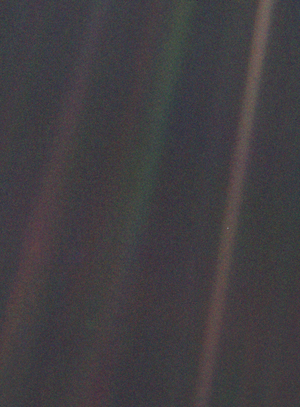
Seen from about 6 billion kilometers (3.7 billion miles), Earth appears as a tiny dot (the blueish-white speck approximately halfway down the brown band to the right) within the darkness of deep space.

Astronomer Carl Sagan understood what the world needed, when he helped humanity to get a good look at our little world. In 1990, he requested that Voyager 1 turn its cameras back towards Earth to take the 1990 photo known as "The Pale Blue Dot."

“For small creatures such as we the vastness is bearable only through love.”


This Friday, July 19th, another very special family portrait is scheduled.  NASA's Cassini spacecraft, currently orbiting Saturn, is scheduled to take another photo of Earth, and every Earthling can participate.

The photo is scheduled to be snapped on July 19 between 5:27 and 5:42 p.m. EDT (2127 and 2142 GMT). Earth should be visible as a tiny dot next to Saturn and its rings, with North America and part of the Atlantic Ocean in sunlight at the time.


In this photo by NASA's Cassini orbiter around Saturn, the planet Earth is visible
as the small bright dot. Credit: Cassini Imaging Team, SSI, JPL, ESA, NASA

"My sincere wish is that people the world over stop what they're doing at the time the Earth picture is taken to revel in the sheer wonder of simply being alive on a pale blue dot of a planet, and to appreciate the ever-widening perspective of ourselves and our world that we have gained from our interplanetary explorations," says Cassini imaging team leader Carolyn Porco of the Space Science Institute in Boulder, Colorado.

Blue Marble in the aperture of a camera obscura


"It will be a day for all the world to celebrate."


Sunbeams and moonbeams for everyone.

Let the love shine through.