Showing posts with label Pete Seeger. Show all posts

Friday, August 2, 2013

This Land is Your Land


Photographer Jenna Pope took this photo of a group of women known as the Raging Grannies at this week's Solidarity Sing-Along in the Wisconsin State Capitol.

There are chapters of Grannies all over the world, “out in the streets promoting peace, justice, social and economic equality through song and humour.” The original group of Raging Grannies was formed in 1987 in Victoria, British Columbia, but today you can find "gaggles of Grannies" throughout Canada, Australia, Israel, Scotland, and the United States.  The Raging Grannies have a database of 450 song lyrics on their website that can be used “non-commercially as a form of protest, and not for entertainment,” which states, “You’ve come to the right place if you’re looking for a song to express your outrage about all of those things that threaten our grandchildren’s futures — pollution, militarism, greed, ‘isms and more.”

The Raging Grannies were in the Wisconsin State Capitol in Madison to participate in The Solidarity Sing-Along, which has been happening every week day during the noon hour since Friday, March 2011.  Last week, Capitol Police began enforcing the administrative code which says that groups of 20 or more are required to get a permit.


Jenna was there on August 1st to document some of the 23 citations that were given to both participants and tourists who were there observing the Sing-Along.

A tourist from Arizona is warned that she will be arrested if she doesn't stop singing along.

The Raging Grannies sing this verse to the tune of Woodie Guthrie's This Land Is Your Land:

In the squares of the city, 
in the shadow of the steeple 
In the Capitol, I seen my people 

And some are grumblin’ 
and some are wonderin’ 
If this land’s still made for you and me


© Copyright 1956 (renewed), 1958 (renewed), 1970 and 1972 by Woody Guthrie Publications, Inc. & TRO-Ludlow Music, Inc. (BMI)


Woodie Guthrie's song, This Land Is Your Land, was actually the very first song that the founders of Rooftop School considered when they were looking for a song that the community could sing each day at Morning Circle. 

As I went walking I saw a sign there
And on the sign it said "No Trespassing."
But on the other side it didn't say nothing,
That side was made for you and me.


*******

“Anybody got a rock?
There’s a window back here that needs to be opened!” 


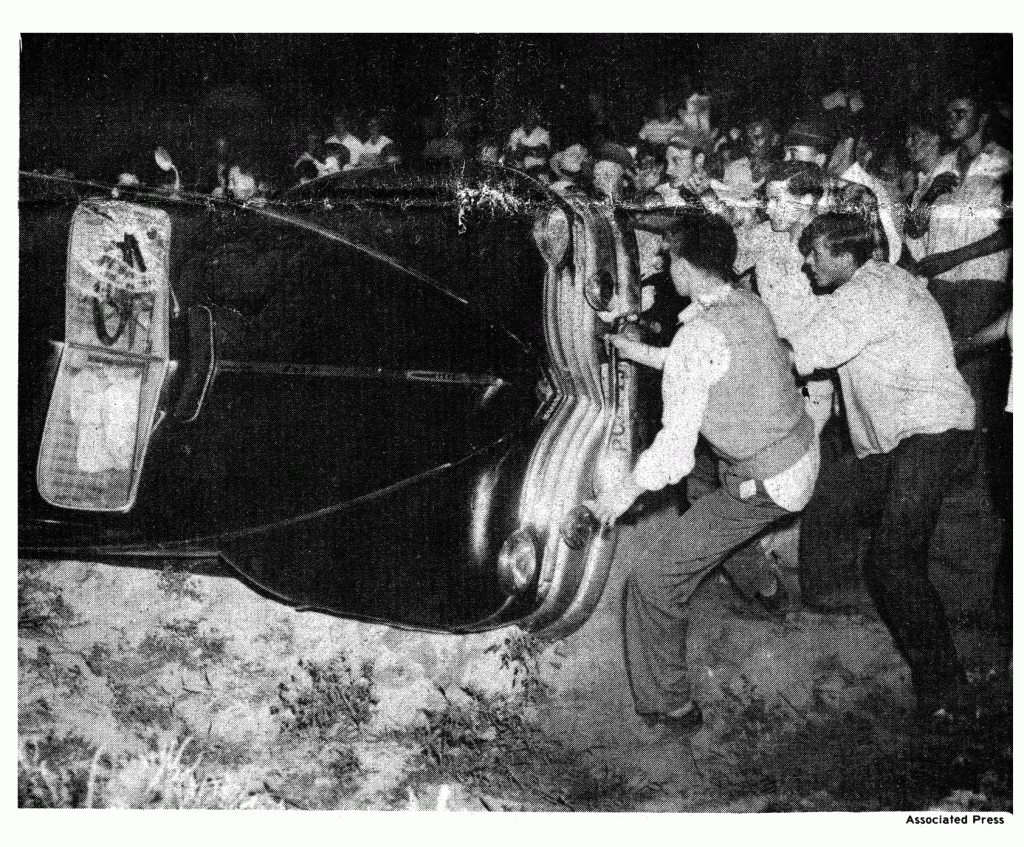
— Woodie Guthrie joked and sang, “We Shall Not Be Moved,” when his car was surrounded by an angry mob after a performance in Peekskill, New York.  


The 1949 outdoor concert with Guthrie, Pete Seeger, Harry Belafonte and Paul Robeson, benefitting the Civil Rights Congress, prompted one of the ugliest days in music's history. Known as The Peekskill Riots, angry locals from Westchester County New York took to throwing racial slurs and rocks in response to Paul Robeson's scheduled performance at an open-air concert in Lakeland Acres, north of Peekskill, on September 4th, 1949.


*******

There is a long history of social protest through song in America. The civil rights movement used songs as an expression of dissent, and this tradition has been carried forward with every movement thereafter. Rooftop School began exploring this history with Marcus Shelby's oratorio, Soul of the Movement: Meditations on Dr. Martin Luther King, Jr. 

“With this music, a rich heritage from our ancestors who had the stamina and moral fiber to be able to find beauty in broken fragments of music, whose illiterate minds were able to compose eloquently simple expressions of faith and hope and idealism, we can articulate our deepest groans and passionate yearnings-and end always on a note of hope that God is going to help us work it out, right here in the South where evil stalks the life of a Negro from the time he is placed in the cradle.  Through this music, the Negro is able to dip down into wells of a deeply pessimistic situation and danger-fraught circumstances and bring forth a marvelous, sparkling, fluid optimism.  He knows it is still dark in his world, but somehow, he finds a ray of light”.

— Dr. Martin Luther King, Jr.


Thursday, August 1, 2013

Versus to Verses


Pete Seeger's banjo head is inscribed with the singer's motto:

This Machine Surrounds Hate and Forces it to Surrender.  


The slogan on his banjo head is a tribute to American singer-songwriter Woodie Guthrie, who helped Seeger, who had just dropped out of Harvard, to discover his life's work.
"He went through WWII with a piece of cardboard pasted to the top of his guitar: 'This machine kills fascists,' " Seeger says on the recording. "He really wanted his guitar to help win the war against Hitler. When Woody went into a hospital in 1952 ... I put something similar on my banjo: 'This machine surrounds hate and forces it to surrender.' "

The banjo is now on display at the Rock and Roll Hall of Fame Museum.
 Curatorial Director Howard Kramer shares insight on his conversation with Seeger and why he decided to put his infamous banjo head in the Museum instead of on auction.

Available for free download on the Internet Archive: Hear Your Banjo Play (1947) — Pete Seeger plays his banjo and narrates the story and presents the origin of the banjo, the development of southern folk music and its influence upon Americans.

*******

“Participation!  It's what my work has been about.”


For over 70 years, Pete has been leading audience sing-a-longs.  Singing with young and old, rich and poor, new voices and familiar voices. He has probably done more to instill a love of community singing than any other American.  At Seeger's 90th Birthday Concert, Bruce Springsteen talked about the moment when he and Pete sang “This Land Is Your Land” together at Obama's inauguration.
... At some point Pete Seeger decided he'd be a walking, singing reminder of all of America's history. He'd be a living archive of America's music and conscience, a testament of the power of song and culture to nudge history along, to push American events towards more humane and justified ends. He would have the audacity and the courage to sing in the voice of the people, and despite Pete's somewhat benign, grandfatherly appearance, he is a creature of a stubborn, defiant, and nasty optimism. Inside him he carries a steely toughness that belies that grandfatherly facade and it won't let him take a step back from the things he believes in. At 90, he remains a stealth dagger through the heart of our country's illusions about itself. Pete Seeger still sings all the verses all the time, and he reminds us of our immense failures as well as shining a light toward our better angels and the horizon where the country we've imagined and hold dear we hope awaits us.
Musician Ruth Ungar, a longtime friend of the family, remembered seeing an old New Yorker cartoon that hung in the Seeger's kitchen.
"It's a woman answering the phone and she's got a baby under one arm, or maybe two. And she's doing the dishes with one hand and mopping the floor with [her] foot," Ungar explains. "And the quote on the bottom says something like, 'I'm sorry, my husband can't come to the phone right now. He's out fighting for the rights of the oppressed.' "

*******


...that she doesn’t sing or dance, she only does housework. A friend at the table who worked with her for decades, and Tinya, her daughter, urged her to take credit for Clearwater, both the sloop and, perhaps more importantly, the Festival (officially known as the Great Hudson River Revival) which has been filling the air with folk music since the 60s.
One talent: She was the key programmer for the Festival. Because she was friends with the people who organized the Folk Life Festival in D.C. and was close friends with George and Joyce Wein, organizers of the Newport Folk Festival where she was a member of the board, Toshi often knew about performers long before they were on most people’s radar, even before most of the members of the Festival planning committee had heard of, say, Tracy Chapman. Clearwater may have paid poorly, but performers came because of Toshi; she was the one who pulled it all together.
“She was the one who steered the boat; she had the chart; she kept us off the rocks.”

At age of 93. Pete performed his wife’s five additional verses to his well-loved song, “Turn, Turn, Turn! (There is a Season),” written in 1954 when Toshi took care of two children ages 6 & 8.  Toshi made up 5 verses for them, and share them for the first time.
The audience is clearly delighted to hear the story from Toshi's perspective.


A time of work
A time for play
A time for night
A time for day
A time to sleep
A time to wake
A time for candles on the cake

A time to dress
A time to eat
A time to sit 
and rest your feet
A time to teach
A time to learn
A time for all to take their turn

A time to cry and make a fuss
A time to leave 
and catch the bus
A time for quiet
A time for talk
A time to run, a time to walk

A time to get
A time to give
A time to remember
A time to forgive
A time to hug
A time to kiss
A time to close your eyes and wish

A time for dirt
A time for soap
A time for tears
A time for hope
A time for Fall
A time for spring
A time to hear the robin sing

To every thing
Turn, turn, turn
There is a season
Turn, turn, turn
And a time for every purpose under heaven


Sing-along

sing-along — /sing euh lawng , long /, n. 1. an informal or unrehearsed singing of songs by a group of people, usually under the direction of a leader; songfest. 2. an occasion marked by such singing. Also, singalong. [1955 60; n. use of v. phrase sing along] … 

It was surprising to discover that the use of the verb phrase “sing-along” as a noun, first occured in 1955.  A little Internet research reveals that bandleader Mitch Miller recorded The Yellow Rose of Texas with a chorus of singers in 1955. The popularity of that number one Billboard hit then led to his first albums of standards, accompanied by lyrics that let people sing along. His television show, Sing Along with Mitch, aired from 1961-1966, inviting thousands of Americans at home to sing along with a bouncing ball - which they did, in the privacy of their own homes.

New advances in technology are enabling scientists and researchers to explore how the arts can assist with the social emotional health.  Today, brain research is exploring the impact of singing on mental health for the young and the old. First 5 California states that 90% of a child's  brain develops in the first five years of life.  Cognitive neuroscientist Julene Johnson, in partnership with the Community Music Center and the San Francisco Department of Aging and Adult Services is currently researching the impact of community singing on the health of older adults

At Rooftop School, Friday Sing-Along and the Rooftop Afterschool Chorus sessions are seeding the musical memory banks of our students.

Try singing along with these children’s songs about windows: 

is a silly mash up of different nursery stories. 

is a seasonal song sung by Rosemary Clooney & Gene Autry

is a song that can be done with a dance.

Mary Ann shares a wonderful pair of songs sung by Pete Seeger to the same melody: 
Fly Through My Window is a list song about birds — with verses about the robin, bluebird, crow, bobwhite, whip-poor-will, hummingbird and Seeger even incorporates their songs within the song.

Little bird, little bird, fly through my window
Buy molasses candy.

Fly through my window, my sugarlump
And buy molasses candy. 


To hear more bird song, visit the Cornell Lab of Ornithology Online Bird Guide http://birds.cornell.edu/onlineguide/ 

The melody is the same, but the words and purpose for the song are changed 

Little girl, little girl, see through my window
See what you can see

I see the rich
I see the poor
I see millions, millions more
Around the ringo-world-o

I see the the clever
I see the smart,
I see the folks who have no heart
Around the ringo-world-o

I see a world
Where you and me 
Can dwell in sweet serenity
Around the ringo-world-o